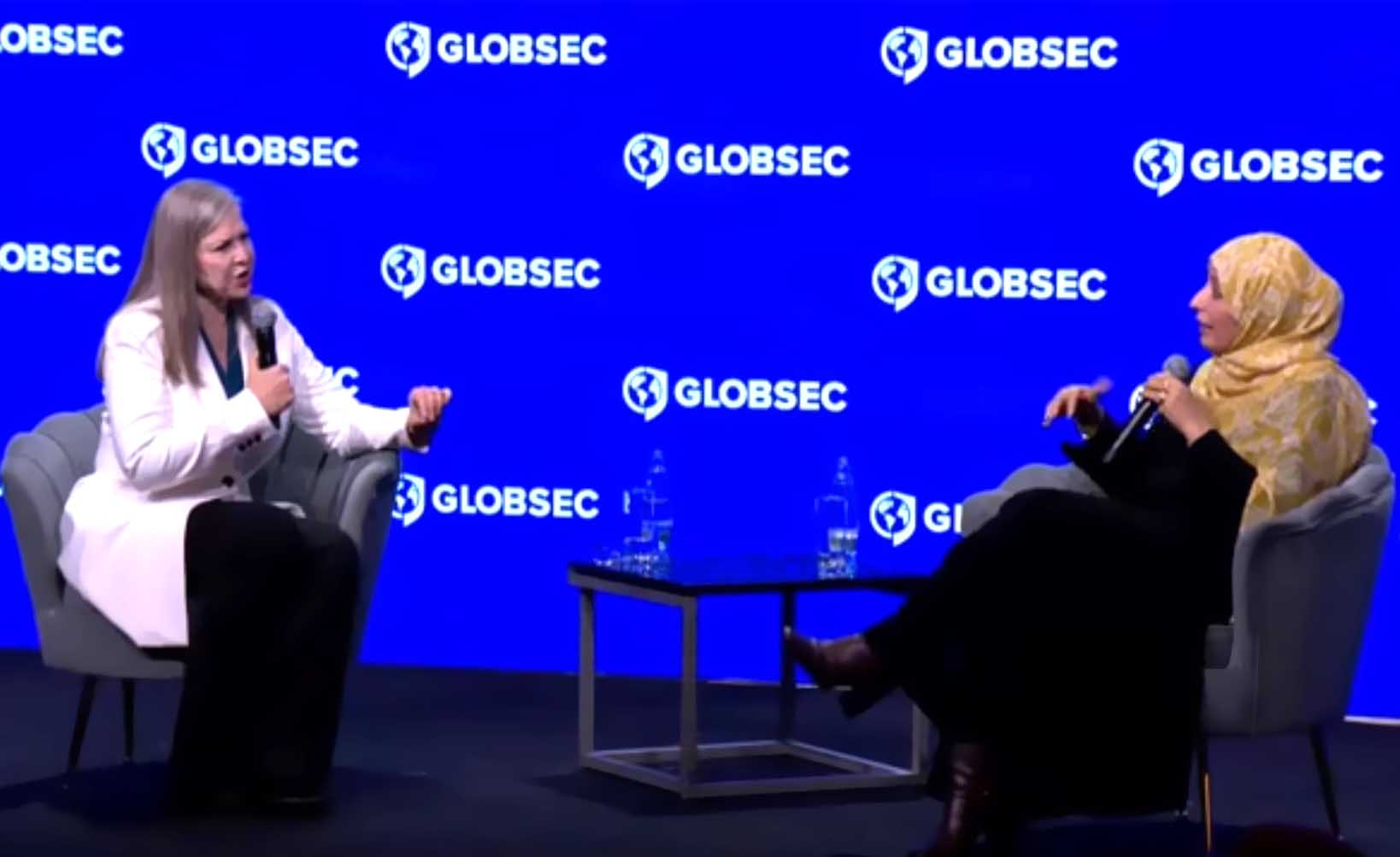

Yemen is currently enduring the most perilous chapter in its modern history, crippled by a dark, dynastic Houthi insurgency that has effectively transformed the war-torn nation into a forward operating base for Iranian geopolitical ambitions, human rights activist and Nobel Peace Prize laureate Tawakkol Karman warned on Friday.
Speaking at the high-level Global Security and Policy Forum (GLOBSEC 2026) in Prague—held under the auspices of Czech President Petr Pavel—Karman delivered a scathing assessment of the security architecture in the Middle East. She cautioned world leaders that the Houthi militia’s maritime chokehold grants Tehran an unprecedented asymmetric advantage over global trade.
Karman explained to an audience of international policymakers and diplomats that through the Houthi proxy footprint in Yemen, Iran now commands a level of strategic leverage over the Red Sea that surpasses its influence over the Strait of Hormuz by tenfold.
A Hijacked Revolution and Regional Collusion
Addressing the root causes of the crisis, Karman challenged the conventional narrative surrounding the group's ascension. She argued that the 2014 capture of Sana'a was not merely an overnight Iranian achievement, but rather the byproduct of broader regional complicity and international collusion calculated to derail the democratic momentum of the Yemeni Spring.
While noting that the Houthis were not a purely Iranian creation at the outset, Karman clarified that Tehran expertly moved in to hijack the political vacuum, capitalizing on the counter-revolutionary forces to fully co-opt and direct the militia. She further asserted that the group now operates as an extension of Iran’s regional axis, striking precisely when and where Tehran dictates, closely mimicking the Hezbollah model in Lebanon.
The Nobel laureate also offered a candid critique of the anti-Houthi coalition, pointing to a stark asymmetric reality on the ground where the internationally recognized legitimate government remains weak militarily, logistically, and administratively, despite nominally holding the largest geographical share of the country. Without robust, coordinated international backing to build state capacity, she warned that the government cannot fulfill its sovereign responsibilities.
Weaponizing the Bab al-Mandab Strait
Analyzing the volatile dynamics of global maritime shipping, Karman dismissed the notion that the relative traffic through the Bab al-Mandab Strait is governed by diplomatic backchannels or regional understandings with the United States and Saudi Arabia. Instead, she characterized the current situation as a calculated tactical pause by Iran.
According to Karman, Tehran is intentionally holding the Bab al-Mandab card in reserve for two primary strategic reasons:
• Geopolitical Leverage: Retaining a destabilizing trigger-point should European powers and NATO align more aggressively under a shifting U.S. administration.
• Deterrence: Avoiding a catastrophic maritime shutdown that would inevitably force a hesitant NATO and a reluctant Europe into a direct, boots-on-the-ground military intervention.
She concluded that the geopolitical reality remains absolute, and with Houthi proxies firmly anchored at the mouth of the Bab al-Mandab, Tehran is effectively exercising near-total dominance over the Red Sea corridor.
The Path Forward: Restoring Consensus
When pressed on a viable resolution for the protracted conflict, Karman advocated for a strict return to the democratic frameworks established prior to the joint Houthi-Saleh coup.
She stated that the solution is as straightforward as it is urgent, requiring the international community to apply maximum, unyielding pressure on the Houthi faction while simultaneously providing comprehensive economic, military, and institutional support to the legitimate government. This dual-track approach, she argued, is the only viable mechanism to stabilize liberated zones and systematically restore state authority nationwide.
Defending the enduring legacy of the 2011 Arab Spring, Karman concluded with a resilient defense of the region's democratic aspirations, describing the original uprisings as a necessary historical correction against institutional corruption and autocracy.
While regional coups and counter-revolutions have temporarily plunged the Middle East into civil conflict and economic ruin, Karman maintained that the underlying drive for self-determination remains unbroken and that successive rounds of popular resistance will endure until the peoples of the region safely reach the shores of freedom and human dignity.