From State Erosion to Global Fracture: Tawakkol Karman’s Oxford Address
Hello everyone,
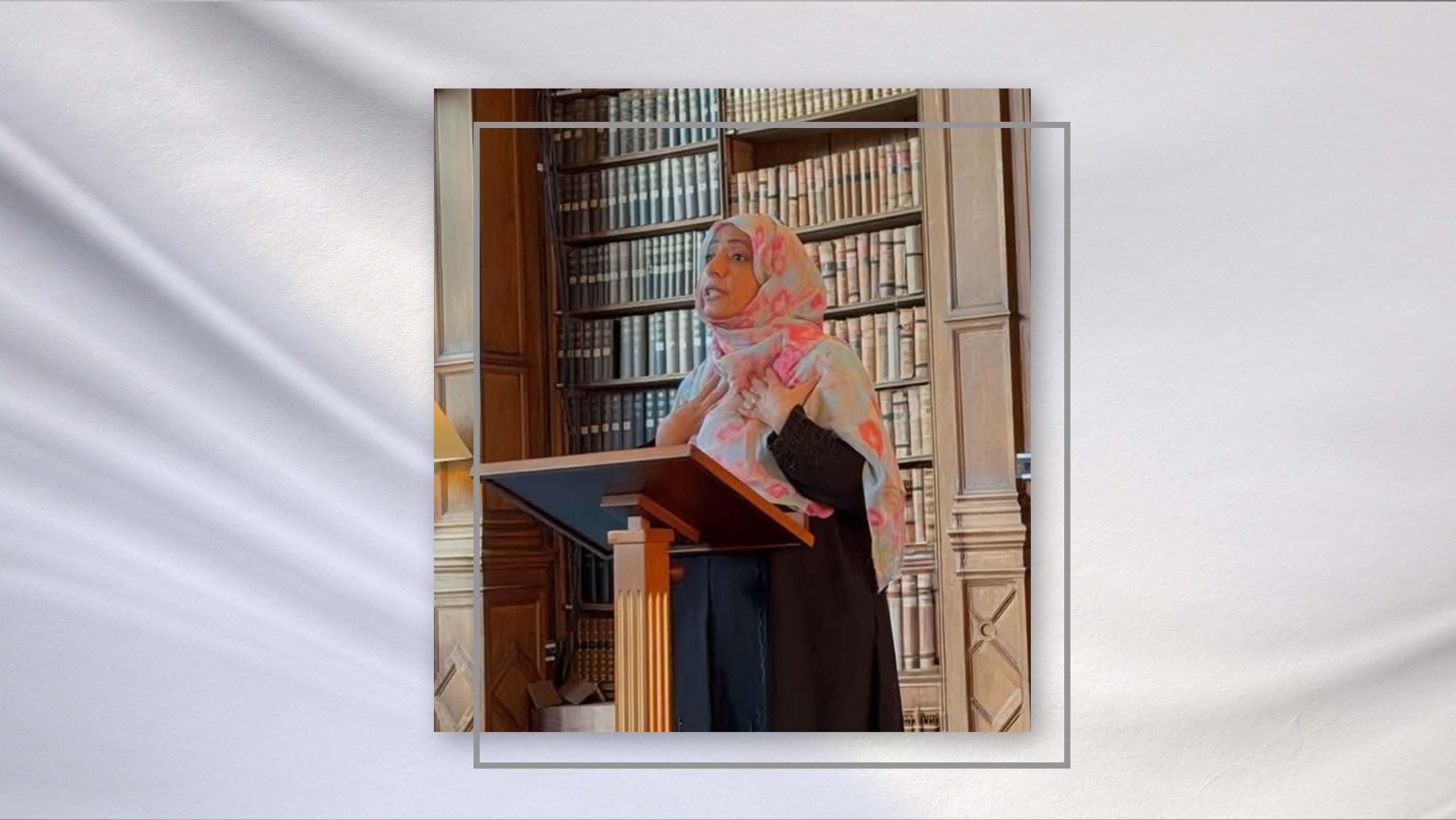
I thank Oxford University and its Student Union for the honor of meeting with its students once again, and for the chance to reflect together on the critical challenges of our time.
We gather at a historic moment—not a set of isolated crises, but a profound reshaping. The foundations of the nation state are eroding, the global order is fracturing, societies are fraying, and values once thought secure are in retreat.
This decline is interconnected: when the state weakens, communities unravel; when law is abandoned, force prevails; and when values are sidelined, tyranny and oppression—even atrocity—find justification.
Let us begin with the erosion of the nation state.
This erosion occurs when internal despotism converges with external intervention. Despotism does not merely stifle politics; it strips the state of meaning, reducing it from a framework of unity to an instrument of control.
Yet the modern state, at its core, is not an apparatus of oppression. It is a moral and political construct, founded on a social contract in which power is entrusted in exchange for security, rights, and justice. Its legitimacy rests on the rule of law, independent institutions, equal citizenship, and the popular will—anchored in a national identity that safeguards human dignity.
This idea has been eroded. In many countries, the state has shifted from representing society to guarding it, from guaranteeing rights to monopolizing power. Authoritarianism is no longer an exception but an entrenched system, sustained by networks of loyalty, fear, and corruption. Armies serve rulers rather than constitutions, judiciaries lose independence, and economies are managed through patronage instead of public policy.
Thus emerges the “fragile state in disguise”: outwardly stable, yet hollow within. When its authoritarian facade collapses, no institutional transition occurs. Instead, a vacuum opens, filled by militias, armed identities, and sub national loyalties. This explains why several states—including those touched by the Arab Spring—collapsed so swiftly once their regimes fell.
Yet despotism alone does not explain state disintegration. A state weakened from within becomes an open arena for foreign intervention. Regional and international powers step in, not to rebuild, but to exploit fragility—pursuing policies cloaked in the language of security, counterterrorism, and crisis management. These strategies rely on economic pressure, debt, sanctions, and the empowerment of proxy forces, deepening the state’s vulnerability rather than restoring its foundations.
When rulers fall under the weight of popular demands and revolutions—often of their own making—external powers rush to exploit the ensuing chaos. They construct parallel state structures, empower militias, and normalize them under the banner of “political realism.” The result is a deliberate maintenance of states in a condition of neither war, nor peace, nor genuine statehood—a gradual hollowing that empties the state of substance without formally dismantling it.
Disintegration and partition are then presented as the only “realistic” path, blocking any authentic democratic transition. In truth, these maneuvers serve one purpose: to secure continued dominance and influence—direct or indirect—over geography, resources, and wealth.
This is precisely what unfolded during the Arab Spring. The uprisings of 2011 were a historic attempt to reclaim the state from tyranny, corruption, and subservience. They were not acts of chaos, but revolts against reducing the state to the ruler and his narrow circle of interests. Yet these movements collided with a hostile regional and international environment. Powers fearful of democracy viewed any genuine transition—any strong, law based institutions—as an existential threat, and worked systematically to prevent them.
In this context, one state stands out: the United Arab Emirates. With vast wealth, it has pursued a deliberate project to dismantle nation states. From Sudan to Libya, Somalia to Yemen, its policies have supported militias, torn apart social fabrics, and re engineered conflicts to block stability and the rise of independent civil states. This is not traditional influence, but a strategy of controlled disintegration—producing neither security nor order, but reproducing chaos as a tool of dominance.
This description applies equally to the mullah regime in Tehran, which undermines states, fuels conflicts, and weaponizes sectarian identities across borders. Together, these two forces pose a grave threat to regional and international peace and security.
In Yemen, the peaceful February 11th Revolution opened a promising path of transition and national dialogue. Yet this process was systematically attacked—backed by Iran through the Houthi militia allied with Ali Abdullah Saleh—culminating in the September 2014 coup. As the coup spread, the Saudi Emirati coalition intervened in 2015 under the banner of restoring legitimacy. Instead of achieving that goal, the war eroded legitimacy, usurped national decision making, and dismantled the state.
The Emirati role, in particular, pursued fragmentation: reshaping geography and society, funding armed forces outside government authority, and controlling islands, ports, and coastlines. Ironically, this did not confront the Houthis as an existential threat. On the contrary, it weakened legitimacy and allowed the Houthis to consolidate power in the north, presenting themselves as defenders of Yemen’s sovereignty.
In Sudan, this pattern is stark. After a revolution that opened the horizon for a civilian state, the Rapid Support Forces were empowered as a parallel militia—funded and armed as a cheaper instrument of influence than the state itself. They soon challenged state authority, and with conflict, the failure was not only of the revolution but of a regional approach that replaced institutions with fragmentation. The crimes committed reflect the logic of illegitimate weapons and foreign intervention, turning collapse into a project of external control.
Libya followed a similar trajectory. After the regime’s fall, institutions were denied the chance to rebuild. Instead, militias, sponsors, and external agendas filled the vacuum, leaving the state absent and conflict perpetual.
Somalia too reflects this logic, where division is legitimized rather than state failure addressed—seen in the recognition of Somaliland. Fragmentation here creates a dangerous vulnerability in the Horn of Africa.
Across these cases, the trend converges: regional powers seeking influence through militias, an Israeli vision exploiting state weakness, and an international system lax in protecting sovereignty. Together, they make dismantling the nation state not only possible, but tempting.
This trend aligns with regional fragmentation projects, even when the rhetoric differs. When regional powers seeking influence through militias converge with an Israeli vision exploiting state weakness, and an international system lax in defending sovereignty, dismantling the state becomes not only possible but tempting.
The lesson from numerous experiences is clear: partition—whether declared or imposed—has never ended conflict. Instead, it reproduces it in more complex forms. The entities born of fragmentation are neither stable nor democratic; they survive on external protection and exist in perpetual tension.
A fragmented Yemen is not only a danger to its society, but a direct threat to the security of the Red Sea, Saudi Arabia, the Gulf, and the wider Arab world, as well as global energy routes. Yemeni unity is therefore not an ideological slogan, but a fundamental condition for regional and global stability. Without it, there can be no lasting peace or security.
The same holds true elsewhere. A divided Somalia opens a strategic gap in the Horn of Africa, with repercussions reaching the Gulf. A collapsing Sudan disrupts Egyptian national security and spreads instability deep into the Arab and African worlds.
Thus, the clash between state building and state dismantling repeats across multiple arenas. These are not isolated local crises, but an integrated regional pattern of influence built on weakening the nation state. This path has proven incapable of producing stability or resolving conflicts; instead, it internationalizes them, turning Yemen, Somalia, and Sudan into direct threats to regional and global peace.
Conversely, preserving and building the unity of states remains the only viable framework for a future where life expands, stability prevails, and societies’ basic needs—food, education, health, employment, and dignity—are fulfilled.
More dangerously, the dismantling of one state sets a precedent that threatens all others. From this perspective, the defense of the nation state by Saudi Arabia, Egypt, and Turkey is not mere political solidarity, but a strategic recognition that collapse anywhere breeds instability everywhere. For all its flaws, the state remains the only framework capable of containing violence, regulating interests, and preventing geography from becoming a vacuum.
The responsibility of the international community therefore stems not only from sympathy, but from self interest. Chaos in this region—with its depth, maritime routes, and political weight—poses a direct threat to global stability. Unless the project of dismantling states is confronted clearly and firmly, the entire international system will remain vulnerable to policies of transnational chaos.
Dear friends,
The disintegration of states cannot be separated from the broader fracturing of the global order. The decline of democracy, disregard for international law, double standards, and the return of expansionist ambitions have entrenched a logic of force over law. Sovereignty is no longer safeguarded, and the principles that shaped the post World War II order are eroding.
What we face is not only an imbalance of power, but a profound crisis of legitimacy. A system built on law and institutions has become selective—rules applied when they serve the powerful, suspended when they protect the weak. In such a world, double standards hollow out institutions and strip them of deterrence. The Russian invasion of Ukraine marked a turning point, breaking taboos by redrawing geography through force, in blatant violation of sovereignty and territorial integrity.
This collapse reached its most egregious peak in Gaza, where massacres, the destruction of cities, and the targeting of civilians unfolded under international silence and complicity. Here, law was not merely suspended but emptied of meaning. Concepts such as “self defense” were distorted into justifications for mass killing, while victims were criminalized for demanding the right to live.
Gaza was no exception. It was preceded by Iraq and Afghanistan—states destroyed under false pretexts, without accountability, sending a dangerous message: force can devastate, but it cannot build or secure peace.
In Latin America, the rhetoric of “democracy” and “fighting drugs” masked interventions that usurped sovereignty and plundered resources, as in Venezuela. Yes, Maduro is a dictator who oppressed his people, and we support their struggle for freedom. But this does not justify the United States’ kidnapping of him outside the bounds of international law. Justice belongs to legitimate institutions, not to piracy or mafia logic. The Trump administration’s approach—undermining the UN, multilateralism, and international law while enshrining deals and brute power as “neo realism”—was not reform, but dismantling what remained of shared rules.
Dismantling the global order is no solution. It is a recipe for a world ruled by arms, not justice. What is needed is radical reform: restoring international law as binding for all, reforming global governance institutions—above all the Security Council—ending veto privileges that obstruct justice, holding corporations accountable, and redefining peace not as a deal imposed by force, but as the fruit of justice.
My dear friends,
The fragmentation we witness today is not confined to the state or the international order; it reaches into societies themselves. The social fabric is torn, trust erodes, and coexistence weakens. Under wars, tyranny, inequality, and exclusionary rhetoric, the idea of society as a shared human partnership diminishes. Narrow identities rise, and difference—once a source of richness—becomes a tool of conflict and hatred.
In the Arab world, religious and sectarian diversity—Sunni and Shia, Muslim and Christian, Jewish and Druze, Arab and Kurd—has been transformed from a source of richness into fuel for division and violence. Yet the real struggle has never been between these identities, but between freedom and tyranny. Tyrants, colonizers, and regional and global powers have manipulated non national identities as instruments of conflict, dismantling societies, undermining unity, and diverting people from their fundamental struggle for freedom, justice, dignity, equal citizenship, and the rule of law.
In the West, fragmentation appears in escalating ethnic divisions, xenophobia, and rising Islamophobia, alongside sharp polarization between far right and far left. This polarization weakens the social fabric and erodes democracy itself, dragging the state toward decline.
Such fractures are precisely what the alliance of autocrats desires: societies divided from within, easily penetrated, unable to defend their values or systems, rendered fragile and more susceptible to violence and tyranny.
This bleak picture is compounded by widening inequality: immense wealth concentrated in the hands of a transnational few, while millions are pushed into poverty and food insecurity.
This gap is no accident. It is the product of a global economic system designed to serve capital over humanity. At its core stand multinational corporations, no longer mere economic actors but unelected political forces—pressuring governments, profiting from conflict, dismantling societies, and eroding environmental and social laws.
The pressing question, in the face of this disintegration of states and the global order, is: What is to be done?
The answer is not despair, but hope—and above all, courage. Moral courage to speak truth without fear; political courage to confront tyranny, occupation, and the dismantling of states; intellectual courage to resist falsifying peoples’ struggles or normalizing collapse.
First, we must defend both the state and democracy, resisting tyranny wherever it exists. The state is not the enemy of freedom, but its prerequisite when built on equal citizenship, the rule of law, and independent institutions. We must reject the false dichotomy between tyranny and chaos, between the state and freedom. A strong state protects rights; it does not confiscate them. Democracy, likewise, is not a guaranteed inheritance but a daily practice—an ongoing struggle against the dominance of money in politics, unaccountable lobbying, hijacked institutions, and the reduction of elections to empty rituals.
Second, international law must be reaffirmed as binding, not selective rhetoric. Sovereignty cannot be respected selectively, nor crimes punished selectively. Genocide, occupation, and mass killing must be confronted regardless of who commits them or who shields them. Impunity is not neutrality—it is complicity.
Third, dismantling the international order is no solution. Yes, the system is flawed, unjust, and selective, but its collapse would unleash a world ruled by brute force, where destinies are decided by weapons, not rights. Our mission is not demolition, but radical reform: law applied to all without exception, accountable global institutions, and a Security Council no longer paralyzing justice in the name of the veto.
Fourth, we must reject all policies rooted in division—whether sectarian, ethnic, racist, or ideological. Our true struggle is not between identities, but between freedom and tyranny, between citizenship and domination. Societies are not preserved by erasing difference, but by harmonizing it within a shared political and ethical framework.
Fifth, we must hold governments and corporations accountable for what they do in our name, with our money, and with our power. We must not grant them a blank check to finance wars, support tyranny, dismantle states, or profit from chaos. Accountability is the essence of democracy. When power is unchecked, it becomes a danger; when values are silenced, crime finds its door open. A just world cannot be built while transnational corporations dominate the economy, shape knowledge, and control the public sphere without oversight. Social justice, environmental protection, and the regulation of technology companies are not peripheral concerns—they stand at the very core of the struggle for the future.
Finally, I speak to you with complete clarity: hope rests with you—the youth; university students and professors; thinkers, writers, artists, and pioneers of knowledge, thought, and creativity. History has always been transformed by generations of students, thinkers, and young people who refused to live without meaning and without dignity. Do not wait for permission to be ethical, nor for consensus before speaking the truth.
I trust the people. I place my faith in them. And today, more than ever, I place my faith in the younger generation.
I see them in the streets across the world, in demonstrations that transcend borders, raising their voices against war, genocide, injustice, and the hypocrisy of their own regimes. I see them linking Palestine, Ukraine, Sudan, Yemen, the climate crisis, and social justice, because they understand what entrenched powers seek to deny: that these struggles are interconnected, and that injustice carries the same face, regardless of geography.
This generation refuses to accept that reality is immutable, because history has taught them that reality changes when people insist on changing it. History is not yet written—the final word has not yet been spoken.
It is the people, not tyrants, empires, or profiteers of war, who will ultimately write its ending.
The road ahead may be long, and the cost may be high. Yet there is no freedom without cost, and no justice without sacrifice. What appears impossible today will become self-evident tomorrow when people insist upon their right to life and dignity.
I believe this deeply, and I invite you to believe it with me—and to take part in writing this future, not merely standing as witnesses to it.
Thank you.